

Athearn Genesis # ATHG-1228 HO GE Dash 9-44CW Locomotive with DCC & Sound, QNSL #404
$619.00
Athearn Genesis


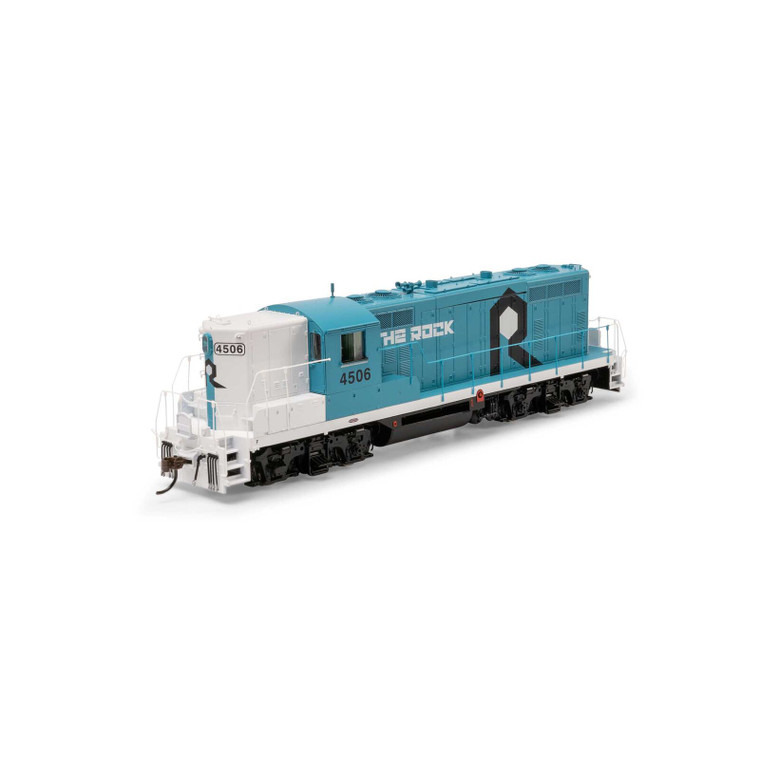
Athearn Genesis # ATHG-1347 HO GP7R Locomotive with DCC & Sound, ROCK #4506
GP7/GP18 SERIES LOCOMOTIVE FEATURES:
Coupler cut levers
Flexible Trainline and MU hoses
Drop steps unless noted
MU stands
“Nub” style walkway tread
Windshield wipe
Lift rings
Wire grab irons
Windshield wipers
Sander lines
NEW! Roof access hatches on non-dynamic units per prototype
Bell placement & type per prototype
Blomberg-B trucks with appropriate bearing caps
Speed recorder unless noted
See-through cab windows and full cab interior
Fine-scale Celcon handrails for scale appearance
Etched metal radiator intake grilles and fan grilles
Air tanks mounted below sill unless noted
Body-mounted McHenry® scale knuckle couplers - Kadee® compatible
DCC-ready features Quick Plug™ plug-and-play technology with 21-pin NEM connector
Scaled from prototype resources including drawings, field measurements, photographs, and more
Accurately-painted and –printed paint schemes
Genesis driveline with 5-pole skew wound motor, precision machined flywheels, and multi-link drivetrain
All-wheel drive with precision gears for smooth & quiet operation
All-wheel electrical pickup provides reliable current flow
Wheels with RP25 contours operate on all popular brands of track
Bidirectional constant LED lighting so headlight brightness remains constant
Heavy die-cast frame for greater traction and more pulling power
Packaging securely holds model for safe storage
Minimum radius: 18” — Recommended radius: 22”
SOUND-EQUIPPED MODELS ALSO FEATURE:
Onboard DCC decoder with SoundTraxx Tsunami2 so
Dual cube speakers for optimal sound quality
Sound units operate in both DC and DCC
Full DCC functions available when operated in DCC mode
Engine, horn, and bell sounds work in DC
All functions NMRA compatible in DCC mode
Precision slow speed control
Program a multiple unit (MU) lashup with lead unit only horn, bell, and lights
Many functions can be altered via Configuration Value (CV) changes
CV chart included in the box
ROAD NUMBER SPECIFIC FEATURES:
#1775 Standard simplified scheme w/o end stripes
#1776 Bicentennial scheme w/ beacon
#1777 Early scheme w/ end stripes and dual side road numbers
#7496 Ex-Lehigh Valley #302
#7499 Ex-Lehigh Vallley #305, hood mounted paper air filter box, modified cut left skirting
945 Dynamic brakes, long hood forward operation, 5-chime Leslie horn, exhaust spark arrestors, hood-mounted bell, NW modified left side skirting with access doors
#949 Dynamic brakes, long hood forward operation, 5-chime Leslie horn, exhaust spark arrestors, hood-mounted bell, NW modified left side skirting with access doors
#2704 Ex-NKP, Short hood forward, front gyralight (effect in DCC), short hood mounted bell, exhaust defectors, right side winterized window
#171X Ex-CG 171, Nathan P5 horn, pilot mounted foot boards, hood mounted bell, SOU paint with “C of G” sub lettering
#175 Ex-CG 175, Nathan P5 horn, pilot mounted foot boards, hood mounted bell, SOU paint with “Central of Georgia” lettering on long hood
#179H Ex-TA&G 50, Nathan P3 horns with all
#4506 Late small louver battery box doors, standard EMD fuel tank, optional Whip antenna for current version in poly bag
#4523 Late small louver battery box doors, rebuilt Rock Island style fuel tank
#4540 Early large louver battery box doors, rebuilt Rock Island style fuel tank
CNW FEATURES:
Late walkway with inspection holes
Large 2350 gallon fuel tank
Winterization hatch
Early pilots with footboards
Frame side-mounted air tanks
Dual “Blatt” horns
Non-dynamic bakes
CCT FEATURES:
NEW! Non-Dynamic with roof access hatches
Front and rear gryalights (effect in DCC)
Ex-Rock Island
1700 gallon fuel tank
Partial skirting above fuel tank
Wheel bearings per prototype
Nathan P5 horn
MSRC FEATURES:
NEW! Non-Dynamic with roof access hatc
1700 gallon fuel tank
Short hood mounted bell
Nathan P3 horn with all bells forward
CR FEATURES:
Ex-Lehigh Valley
Winterized hatch
Dynamic brakes
Nathan K3 horn
Smaller 1300 gallon fuel tank
NEGS FEATURES:
NEW! Non-Dynamic with roof access hatches
1700 gallon fuel tank
Ex Rock Island #1341
Dual cab strobes (effect in DCC)
Non-dynamic brake
Front and rear plows
Nathan P5 horn
Expert provided artwork
SBC FEATURES:
Eye-catching orange paint scheme
Leslie 3-chime horn
Dynamic brakes
1700 gallon fuel tank
NW FEATURES:
Pelver blue scheme with the “hamburger” logo
Dynamic or Non-Dynamic per road number
1700 gallon fuel tank
Pilots with footboards
SOU FEATURES:
Ex-CG/TA&G
Non-dynamic brakes
Short hood forward operation
Horn and bell placement per road num
Small 1300 gallon fuel tank
ROCK FEATURES:
NEW! Non-Dynamic with roof access hatches
Early Pyle headlights
Firecracker antenna
Early “pipe” style handrails
Nathan P-5 horn
PROTOTYPE AND BACKGROUND INFO:
In 1949, EMD introduced the GP7. The basic design followed most diesel switchers with the addition of a short hood instead of an end-cab. The hoods were also full height to better accommodate the diesel engine and mechanical and electrical components.
Many railroads chose to rebuild their GP7s and GP9s for continued service. Often times, it was cheaper to do this rather than purchasing brand-new locomotives. Some railroads adopted a GP7R designation to indicate a rebuilt unit.
The EMD GP18 began production in late 1959 and was based on the builder’s extraordinarily successful GP9, although the latter model was still in production at the time. The GP18 is considered the last of the builder’s “first generation” models. Similar in appearance to the GP7 and GP9, the GP18 was slightly more powerful and came with the option of a low or high short cab hood, something that had only been upon special request with EMD’s first two road switcher models. It used the final version of General Motors first locomotive prime mover, the 16-cylinder model 567D1 which could produce 1,800 horsepower, the most powerful in the series up to that time. At just over 56 feet in length the GP18 was the same length as its predecessor models and was visually very similar, with the exception of new radiator grills which were also used on the GP20.
While thousands of GP7s and GP9s were produced just a few hundred GP18s were ultimately built for a little more than two dozen railroads. Today, several GP18s remain in operation on numerous shortlines and industrial operations around the country.
Athearn Genesis
Athearn Genesis

Athearn Genesis
Athearn Genesis